Showing posts with label precautions. Show all posts

Friday, November 20, 2009

Defend vs. Destroy

A reader writes in to ask how to defend against vampire attacks. I have mixed feelings about this, because too often "defense" morphs into "destroy," as in this excerpt from the Second Congressional Report:

Despite their Dark magic, or perhaps because of it, vampires are vulnerable to the more powerful forms of warding- and (less often) seeking-magic. They cannot be destroyed by magic, however. Well-made wards created by reputable magicians are generally sufficient to protect homes, modes of transportation, and places of business. Personal wards are somewhat effective but can be overpowered in a determined attack. Garlic and holy items (such as crosses) are only the most well-known or traditional elements of an effective ward. Nocturnal predators relying on secrecy, vampires avoid large groups and bright lights. Reports indicate that as more vampires hunt in packs, however, they are more willing to attack greater numbers of humans and in more exposed settings.

Defense against a vampire attack once initiated is much more problematic than the prevention or avoidance of such an attack. Silver bullets are only slightly more effective against vampires than are regular bullets (in contrast to their destructive effect on lycanthropes), unless directly striking the heart. Vampires are by nature so much stronger and faster than humans that staking is virtually never effective during the vampire's nocturnal phase, and attempts usually end in the death of the human defender. Vampires are able to heal quickly even from major wounds. Staking, beheading, or burning by fire or exposure to direct sunlight are the only ways vampires may be destroyed or reach "the final death," as some call it.

Vampire hunting, or deliberately seeking contact with vampires in order to destroy them, is extremely dangerous and should be engaged in only by trained, licensed law enforcement professionals or special military units.

I realize that vampires are dangerous, but it still seems that there must be a way for us to defend ourselves without destroying them. Surely some are worth saving.

Monday, August 3, 2009

Werewolf Moon


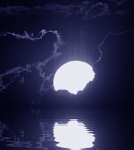
We are currently at 96% full of the Waxing Gibbous Moon, which means that the danger of werewolf attack is at its height. For those who are not adequately briefed on the current phase of the moon, moonconnection.com offers a fairly simple diagram and description:

...the new moon occurs when the moon is positioned between the earth and sun. The three objects are in approximate alignment (why "approximate" is explained below). The entire illuminated portion of the moon is on the back side of the moon, the half that we cannot see.

At a full moon, the earth, moon, and sun are in approximate alignment, just as the new moon, but the moon is on the opposite side of the earth, so the entire sunlit part of the moon is facing us. The shadowed portion is entirely hidden from view.

The first quarter and third quarter moons (both often called a "half moon"), happen when the moon is at a 90 degree angle with respect to the earth and sun. So we are seeing exactly half of the moon illuminated and half in shadow.

Once you understand those four key moon phases, the phases between should be fairly easy to visualize, as the illuminated portion gradually transitions between them.

An easy way to remember and understand those "between" lunar phase names is by breaking out and defining 4 words: crescent, gibbous, waxing, and waning. The word crescent refers to the phases where the moon is less that half illuminated. The word gibbous refers to phases where the moon is more than half illuminated. Waxing essentially means "growing" or expanding in illumination, and waning means "shrinking" or decreasing in illumination.

Thus you can simply combine the two words to create the phase name, as follows:

After the new moon, the sunlit portion is increasing, but less than half, so it is waxing crescent. After the first quarter, the sunlit portion is still increasing, but now it is more than half, so it is waxing gibbous. After the full moon (maximum illumination), the light continually decreases. So the waning gibbous phase occurs next. Following the third quarter is the waning crescent, which wanes until the light is completely gone -- a new moon.

Precautions are in order from the night before through the night after the full moon.